

Views: 0 Author: Site Editor Publish Time: 2026-10-29 Origin: Site


Did you know choosing the wrong prototyping method can waste months of critical product development time? Standing for Stereolithography Apparatus, SLA is the original additive manufacturing technology that revolutionized the industry by creating highly detailed, smooth-surfaced components. In this comprehensive guide, you will learn exactly how the photopolymerization process works. Furthermore, we will explore the underlying cost drivers and objectively compare stereolithography against other leading industrial manufacturing methods to help you make an informed procurement decision.
SLA stands for Stereolithography, a sophisticated resin-based 3D printing process utilizing an ultraviolet laser to precisely cure liquid photopolymers into solid parts.
The technology is widely recognized across the manufacturing sector for producing components with exceptional dimensional accuracy, intricate geometric details, and glass-like surface finishes.
It serves as the ideal foundational technology for visual concept models, complex engineering prototypes, and creating master patterns for secondary manufacturing processes.
Understanding the specific engineering variables behind material consumption and manual post-processing is crucial for optimizing your overall project budget.
Partnering with an industrial-grade manufacturing facility ensures consistent quality, access to specialized engineering resins, and advanced finishing options that desktop machines simply cannot replicate.
To make strategic decisions regarding rapid prototyping, it is essential to grasp the foundational terminology and the underlying scientific principles of the technology you are evaluating.
The acronym SLA stands for Stereolithography Apparatus. Engineers most commonly refer to it simply as Stereolithography. Etymologically, the term is derived from the Greek words stereo meaning solid and lithography meaning writing or printing. Therefore, it literally translates to writing in a solid form.
In the broader context of additive manufacturing terminology defined by global engineering standards, SLA belongs to the vat photopolymerization family. This category encompasses any process where a liquid photopolymer resin is selectively cured by a directed light source within a vat. Specifically, SLA relies on a highly focused ultraviolet laser to map out the cross-sections of a digital model. This targeted ultraviolet exposure creates strong chemical bonds, solidifying the liquid resin into a dense, highly isotropic plastic part.
Stereolithography is not just another manufacturing method. It represents the genesis of the entire additive manufacturing industry. Chuck Hull invented and patented the technology in the mid-1980s. His realization that ultraviolet light could cure photosensitive polymers layer by layer fundamentally transformed product development. Before this breakthrough, creating a physical prototype required weeks of manual machining. Alternatively, it demanded exorbitant investments in preliminary tooling. SLA introduced the concept of rapid prototyping. This innovation allowed designers to hold a physical representation of their CAD data in mere hours.
Looking at current industry trajectories, market analyses reveal a massive shift in how engineering firms utilize stereolithography today. Historically, the technology was confined to rapid design iteration and aesthetic checks. Now, the advent of specialized, high-performance engineering resins is pushing SLA directly into low-volume, end-use production. Modern photopolymers offer heat deflection temperatures exceeding 230 degrees Celsius and enhanced long-term ultraviolet stability. Manufacturers increasingly leverage these advanced materials to bridge the gap between initial concept validation and full-scale injection molding. This strategic shift ultimately optimizes both time-to-market and upfront tooling investments.
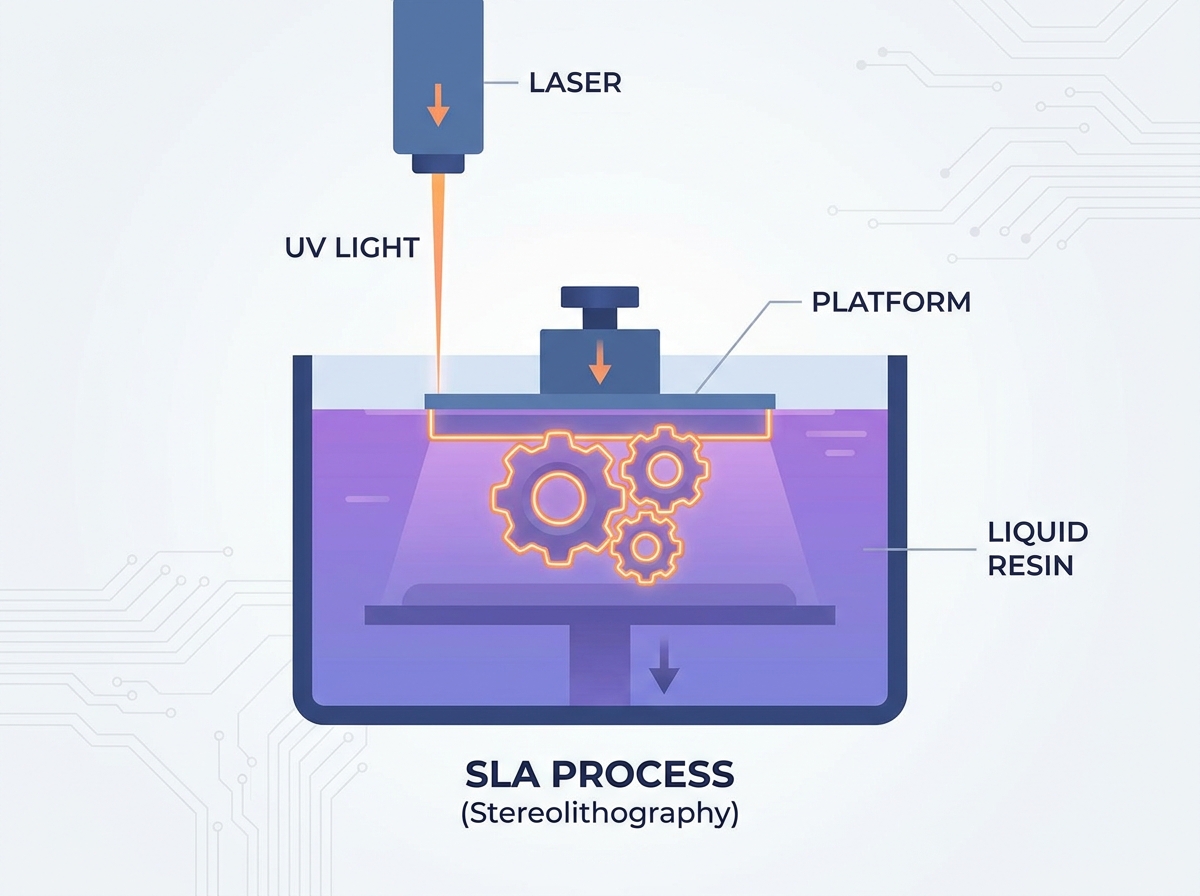
Comprehending the mechanics of the stereolithography process is critical. Engineers must understand these principles to optimize their CAD models for both manufacturability and cost-efficiency.
The printing process operates with high automation. However, it strictly relies on precise environmental and parameter controls to guarantee part accuracy. The workflow generally follows these three core stages:
Digital Preparation: The journey begins with a 3D CAD model exported into a compatible mesh format. Dedicated slicing software imports this file and digitally cuts the geometry into thousands of microscopic horizontal layers. These layers typically range from 25 to 100 microns in thickness. Simultaneously, the software generates disposable support structures. These supports are absolutely necessary to anchor overhangs and isolated features during the physical build.
Photopolymerization: An industrial SLA machine features a large vat filled with liquid photopolymer resin. A perforated build platform descends into this material. Computer-controlled galvanometers act as highly precise mirrors to direct an ultraviolet laser. This laser traces the exact pattern of the first layer onto the surface of the resin. The ultraviolet light triggers a localized chemical reaction. Monomers and oligomers cross-link and solidify instantly.
Peeling and Lifting: Once a single layer is fully cured, the build platform adjusts vertically. This precise mechanical movement allows fresh liquid resin to flow seamlessly over the previously cured layer. The laser then traces the subsequent cross-section. This meticulous cycle repeats thousands of times until the entire three-dimensional object emerges from the vat.
A common misconception in additive manufacturing is that parts are ready for immediate use the moment the printing phase concludes. In reality, SLA components emerge from the printer in a fragile green state. They remain coated in sticky, uncured liquid resin and have not yet achieved their final mechanical properties.
Initially, technicians must submerge the green parts in an agitated solvent bath. Isopropyl alcohol or tripropylene glycol monomethyl ether are standard solvents used to meticulously dissolve residual liquid trapped in micro-cavities. Following the wash cycle, the parts transfer to a specialized curing chamber. Secondary exposure to intense ultraviolet light and thermal heat ensures all chemical bonds fully cross-link. This final step maximizes tensile strength and thermal stability.
Selecting the correct additive manufacturing technology requires a balanced assessment. Engineers must evaluate material properties, dimensional tolerances, and stringent budget constraints. Below is an objective comparison of stereolithography against other leading industrial methods.
Technology | Material Type | Surface Finish quality | Key Advantage |
|---|---|---|---|
SLA (Stereolithography) | Photopolymer Resin | Excellent, Glass-like | Highest resolution and aesthetic detail |
FDM (Fused Deposition Modeling) | Thermoplastic Filament | Rough, Visible layer lines | Cost-effective for bulky geometries |
SLS (Selective Laser Sintering) | Polymer Powder | Porous, Matte finish | No support structures required |
SLM (Selective Laser Melting) | Metal Powder | Rough, Requires machining | Production of dense metal end-use parts |
Fused Deposition Modeling operates by extruding melted thermoplastic filament through a heated nozzle layer by layer. While this method is generally cheaper for bulky or simple geometries, SLA vastly outperforms it in resolution. FDM parts exhibit visible layer lines and a ribbed surface texture. This makes them unsuitable for aesthetic evaluations. In contrast, SLA produces virtually invisible layer lines and a remarkably smooth, injection-mold-like finish. Furthermore, SLA parts are highly isotropic. They offer uniform strength in all directions. FDM parts remain inherently weaker along the Z-axis where the extruded layers bond.
Selective Laser Sintering utilizes a high-power laser to fuse small particles of polymer powder into a solid structure. Unlike SLA, which requires printed support structures that technicians must manually remove, SLS is entirely self-supporting. The unfused powder in the build chamber holds the part in place. This allows for highly complex, interlocking geometries. SLS serves as the superior choice for functional, end-use parts requiring impact resistance and flexibility. However, SLS parts possess a porous, slightly rough surface finish. SLA remains the undisputed winner for fine feature details, sharp edges, and transparent materials.
When plastic prototypes are no longer sufficient for rigorous functional testing, engineers must transition to metal additive manufacturing. Selective Laser Melting operates similarly to SLS but uses a high-wattage industrial laser to fully melt metal powders like aluminum, titanium, or stainless steel. The transition from photopolymers to metals involves a massive leap in capital expenditure. Consequently, the SLM metal 3D printing cost is exponentially higher than resin-based methods. This price increase stems from the strict requirement for inert argon gas environments, expensive atomized metallic powders, and intensive thermal stress relief procedures. Therefore, engineers typically rely on SLA to perfect the form and fit of a design before committing to the high costs of metal printing.
Because of its unique ability to combine tight tolerances with excellent surface aesthetics, stereolithography serves a distinct set of commercial applications across various B2B sectors.
In product development, securing stakeholder buy-in is critical. When presenting a new consumer electronic device or automotive interior component to executives, the prototype must look and feel exactly like the final manufactured product. Technicians can meticulously sand, paint, and clear-coat SLA resins to mimic the exact appearance of injection-molded plastics. This capability makes it the industry standard for ergonomic testing and marketing photography prior to mass production.
One of the most valuable industrial applications of SLA is acting as the foundational step for secondary manufacturing processes. Vacuum casting is used to produce low volumes of production-grade plastic parts without the prohibitive cost of steel injection molds. To create the flexible silicone mold used in this process, technicians first require a flawless master pattern. Any microscopic layer line or surface defect on this master will perfectly replicate in the silicone and transfer to every subsequent cast piece. When budgeting for low-volume production runs, procurement teams must carefully evaluate the vacuum casting master prototype quote. The precision of the initial stereolithography print directly dictates the quality of the entire manufacturing batch.
The SLA process is highly adaptable based on the specific resin chemistry loaded into the vat. The healthcare sector heavily utilizes biocompatible resins to print precise surgical guides, custom hearing aids, and dental aligner molds. Similarly, specialized castable resins are formulated to burn out cleanly without leaving ash residue. Jewelers leverage SLA to print intricate, high-resolution rings and pendants. They then use these prints in the traditional lost-wax investment casting process to create solid metal jewelry.
While stereolithography delivers the smoothest raw output of any standard polymer additive technology, parts do not emerge from the printer ready for end-use presentation. Understanding these post-processing requirements is essential for accurate project budgeting.
When you initiate a manufacturing order, the baseline pricing typically includes a standard finish. This encompasses the mandatory operational steps. Technicians wash away uncured resin, perform ultraviolet post-curing, manually snip away support structures, and apply very light sanding to remove small divots left behind at contact points. The part remains in its natural resin color. It may show minor scuff marks from the localized sanding process, typically achieving a surface roughness around Ra 1.6.
Conversely, if the prototype is intended for a high-stakes marketing presentation, advanced finishing is required. This premium service involves iterative cycles of wet sanding with ultra-fine grit paper, applying automotive-grade primers, and custom Pantone color matching via spray painting. Additional options include high-gloss polishing for optical-clear resins to achieve a glass-like transparency down to Ra 0.1, soft-touch texturing, or even electroplating.
It is vital to recognize that the 3D printing surface finishing cost is predominantly driven by skilled manual labor rather than automated machine runtime. Achieving a flawless, injection-mold-like appearance requires artisanal technicians working meticulously by hand. The complexity of your geometry heavily influences this labor time. A component with deep undercuts, hard-to-reach internal channels, or delicate lattice structures will take a technician significantly longer to sand and paint than a simple, flat electronic enclosure. When requesting a quote, clearly defining the required surface finish grade ensures there are no hidden financial surprises later in the development cycle.
Navigating the procurement process for rapid prototyping requires a clear comprehension of how service bureaus calculate their pricing models. Unlike traditional subtractive manufacturing, where cost is heavily tied to tool wear and material removal, additive pricing is driven by entirely different metrics.
When you submit a digital CAD file to secure an SLA resin prototype printing quote, service providers utilize advanced algorithms to analyze several specific geometric and material variables.
The most direct cost factor is the amount of liquid photopolymer resin consumed. SLA resins are highly engineered chemical formulations commanding a premium price per liter. Furthermore, the volume calculation must include not only the final solid part but also the expendable support structures generated to anchor overhangs during the printing process.
The specific mechanical or thermal properties required for your prototype will dictate the type of resin used. Standard prototyping resins are highly cost-effective for form-and-fit testing. However, engineering-grade resins formulated to simulate thermoplastic behaviors, resist high temperatures, or provide flexibility will significantly increase the material cost due to their complex chemical composition.
Printing at a standard 100-micron layer height is efficient and economical. If your part features microscopic details requiring a 25-micron layer height, the laser must trace four times as many layers. Because industrial SLA machines operate on high hourly rates, increasing the resolution exponentially increases machine runtime, thereby driving up the overall quote.
Engineers can take proactive steps to optimize their CAD files. This reduces material usage and machine time without compromising structural integrity. Solid blocks of resin are expensive and prone to warping due to shrinkage during the curing process. By hollowing out bulky sections of your model and adding strategic drainage holes, you can drastically reduce material consumption. Additionally, orienting the part to minimize severe overhangs reduces the volume of support structures required. This strategy saves both raw material costs and manual labor time during post-processing.
As additive manufacturing becomes increasingly accessible, many engineering firms debate whether to purchase in-house equipment or outsource their prototyping needs. Partnering with a professional facility offers distinct commercial and technical advantages for serious product development.
The term SLA covers a wide spectrum of hardware. This ranges from inexpensive desktop units to massive industrial manufacturing systems. Desktop machines typically use inverted stereolithography. This subjects the part to significant peel forces every time a layer separates from the vat floor. This mechanical stress often leads to dimensional inaccuracies or catastrophic print failures on larger components. Furthermore, desktop lasers lack the precise calibration required to maintain strict industrial tolerances across the entire build platform.
Industrial SLA machines represent hundreds of thousands of dollars in capital investment. Operated by professional services, these systems utilize top-down printing with high-powered, perfectly calibrated solid-state lasers. This eliminates peel forces, allowing for the creation of massive, highly accurate parts. They also feature closed-loop environmental controls. Ensuring resin temperatures remain constant is a critical factor for material consistency and preventing thermal warping.
Relying on a professional manufacturing partner eliminates the hidden total cost of ownership associated with running an in-house laboratory. Managing an SLA facility requires handling toxic liquid chemicals, ensuring proper hazardous waste disposal, and managing volatile organic compound emissions. It also demands dedicating expensive engineering hours to machine maintenance and manual part finishing.
By outsourcing, your organization gains immediate access to a vast portfolio of specialized engineering resins, strict quality assurance protocols, and dedicated finishing departments. This strategic move allows your engineering team to focus entirely on product design and iteration. It ensures your prototypes arrive precisely to specification and ready for immediate testing.
Stereolithography remains the undisputed gold standard for precise, high-fidelity prototyping. By delivering unmatched geometric detail and remarkably smooth surface finishes, this technology perfectly bridges the gap between digital concepts and physical reality. Whether you are developing visual models for executive presentations, evaluating complex internal geometries, or creating flawless master patterns for secondary casting processes, SLA provides unparalleled versatility.
Partnering with industry experts guarantees that your components meet stringent industrial-grade quality controls. To ensure your next project is manufactured to the highest global standards, we encourage you to explore the advanced manufacturing capabilities at Ballgarii. Upload your CAD files to Ballgarii today to receive a customized manufacturing quote, and consult with our engineering team to optimize your production strategy from initial prototype to final product.
SLA is a specific, highly precise category of resin 3D printing. The term resin 3D printing is a broad umbrella that includes SLA, Digital Light Processing, and Masked Stereolithography. SLA specifically utilizes a directed ultraviolet laser to trace and cure the liquid resin layer by layer. This mechanism offers superior precision and surface quality for industrial applications.
While standard SLA resins are inherently somewhat brittle and best suited for visual models, modern material science has advanced significantly. Today's engineering-grade SLA resins can closely mimic the mechanical properties of traditional injection-molded thermoplastics like ABS or Polycarbonate. These tough, durable, or high-temperature formulations are excellent for rigorous functional testing.
SLA is significantly more cost-effective than SLM. SLA utilizes liquid photopolymer plastics, whereas Selective Laser Melting fuses fine metal powders using high-wattage industrial lasers. Consequently, SLM is exponentially more expensive due to the high cost of atomized metal powders, extreme energy consumption, and highly specialized thermal post-processing requirements.
Yes, SLA is highly receptive to secondary cosmetic coatings. Because the technology produces parts with an exceptionally smooth, near-glass-like surface directly from the printer, it serves as the ideal foundational layer for automotive painting, clear-coating, or electroplating. However, specifying these custom aesthetic requirements will require additional manual labor.
The duration of a stereolithography build depends heavily on the height of the part along the Z-axis and the selected layer resolution. A small component printed at 100 microns might finish in a few hours. In contrast, a massive, highly detailed prototype printed at 25 microns could take several days. Additionally, mandatory post-processing steps like washing and ultraviolet curing add several hours to the total production timeline.
In their raw, liquid state, photopolymer resins are considered hazardous materials. They can cause skin irritation and respiratory issues if handled without proper personal protective equipment. Furthermore, uncured resin is toxic to aquatic life and must never be poured down a drain. However, once the resin is fully polymerized and post-cured into a solid plastic part, it becomes completely inert and safe for regular handling.


