

Views: 0 Author: Site Editor Publish Time: 2026-07-28 Origin: Site


Industrial design shapes the devices, equipment, and services used by millions daily. Yet, a costly disconnect persists in modern manufacturing where conceptual aesthetics fail to translate into viable, scalable products. Companies often face the risk of selecting a design partner that excels in conceptual rendering but lacks the engineering rigor to align the external form with manufacturing realities, material constraints, and commercial viability. This gap leads to delayed launches, compromised functionality, and significant manufacturing hurdles.
To overcome these challenges, you must evaluate an industrial design service based on a proven methodology. A successful partnership bridges human-centric aesthetic appeal with structural integrity. It requires advanced capabilities and strict manufacturability standards. By focusing on engineering realities early in the process, you ensure that compelling concepts evolve into robust, market-ready solutions.
Integrated Capabilities: A competent industrial design service must seamlessly merge product appearance design with rigorous structural engineering to prevent late-stage manufacturing failures.
Advanced Modeling Competencies: Modern product development requires verifiable expertise in solid modeling, surface reconstruction, and reverse modeling to adapt existing IP, optimize legacy components, or upgrade industrial equipment.
Risk Mitigation: Evaluating a provider requires scrutinizing their approach to the Inductrial Internal structure and mechanical structure, ensuring design concepts do not violate physical, material (e.g., commercial plastics, alloys), or financial manufacturing constraints.
Vendor Selection Criteria: Shortlisting should prioritize firms that demonstrate a transparent framework for transitioning from the overall external contour to a fully validated overall structure.
Modern product development has shifted away from traditional, siloed design phases. Today, concurrent engineering is the standard. Aesthetics, user experience, and manufacturability must be developed simultaneously. This approach serves both broad consumer markets and specialized industrial sectors. Evaluating a design partner requires looking beyond surface-level portfolios. You need a team that integrates engineering constraints from day one. When a firm understands how a specific polymer flows through an injection mold, they design exterior curves that accommodate proper draft angles and uniform wall thicknesses right from the initial sketch.
Establishing clear success metrics is critical for any design partnership. A capable firm will actively reduce prototyping iterations through accurate initial modeling. They maintain adherence to target unit costs by selecting appropriate manufacturing methods early. Minimal design-for-manufacturing (DFM) revisions serve as a primary indicator of their technical competence. Tracking these KPIs ensures the project remains on schedule and within scope. You should measure success by how few changes the contract manufacturer requests once the final CAD files are handed over.
Cross-sectional industry experience provides a significant advantage. Assess the vendor's track record across diverse sectors. Experience ranging from everyday commercial consumer goods to complex industrial equipment demonstrates adaptability. It ensures they understand specific market demands, usability standards, and regulatory compliance requirements. Broad experience often translates into innovative problem-solving for unique mechanical challenges. A firm that has designed ruggedized enclosures for field equipment will bring valuable durability insights to consumer electronics.
Material and scalability expertise must align with your specific target market. Evaluate the firm's portfolio for relevant material selection experience. They should understand how to optimize thousands of industrial uses for plastics and metals. Their designs must scale efficiently from initial low-volume runs to mass production without requiring complete structural overhauls. Transitioning from urethane cast prototypes to high-cavitation steel tooling requires a deep understanding of material shrinkage rates and cooling channel layouts.
Evaluating a firm's approach to Product appearance design requires analyzing ergonomics and human-centered user interfaces. Products used by millions demand intuitive interaction and clear brand language. Assess how the firm translates user research into physical forms. The design must communicate function while maintaining visual appeal. This involves studying grip zones, button placement, and visual weight distribution to ensure the product feels natural in the user's hands.
You must also assess the feasibility of the proposed Overall external contour. Aesthetic concepts must align with material constraints and tooling limitations. Complex curves might look appealing but can create impossible draft angles for injection molding. Everyday usability should never be sacrificed for a striking visual profile. A sweeping, organic shape must still allow for a straight-pull mold design whenever possible to avoid the need for expensive side-actions or lifters in the tooling.
A critical evaluation of a provider’s structural design capabilities is non-negotiable. The product must withstand real-world operation and environmental stress. Analyze how well the firm integrates the Inductrial Internal structure with the aesthetic shell. They must optimize internal space without compromising the strength of the outer casing. This means strategically placing ribs and gussets to provide rigidity without causing sink marks on the visible exterior surfaces.
The Mechanical structure dictates the lifespan and reliability of the product. Discuss the importance of kinematic analysis for moving parts. Material-specific optimization ensures that ribs, bosses, and wall thicknesses are appropriate for the chosen manufacturing method. Thermal management must also be integrated directly into the structural layout to prevent overheating. If a device contains high-power electronics, the internal chassis must act as a heat sink, directing thermal energy away from sensitive components and user touchpoints.
The vendor's process for resolving conflicts between appearance design and structural design reveals their true expertise. Compromises are inevitable, but they must be managed systematically. A clear workflow ensures that aesthetic intent survives engineering validation. When an internal PCB requires more clearance, the exterior surface must be adjusted smoothly without destroying the original design language.
Specify the documentation and CAD deliverables required at handoff. The overall structure must be fully optimized for the chosen manufacturing method. Whether utilizing injection molding, CNC machining, or die casting, the final files must be production-ready. This includes providing detailed 2D drawings with critical-to-function (CTF) dimensions and geometric dimensioning and tolerancing (GD&T) callouts.
Capability Focus | Primary Objectives | Key Deliverables |
|---|---|---|
Appearance Design | Ergonomics, brand language, user interface | Concept renderings, surface models, CMF documents |
Structural Design | Durability, manufacturability, thermal management | Parametric CAD, DFM reports, FEA analysis |
Integration | Resolving aesthetic and mechanical conflicts | Production-ready assemblies, 2D manufacturing drawings |
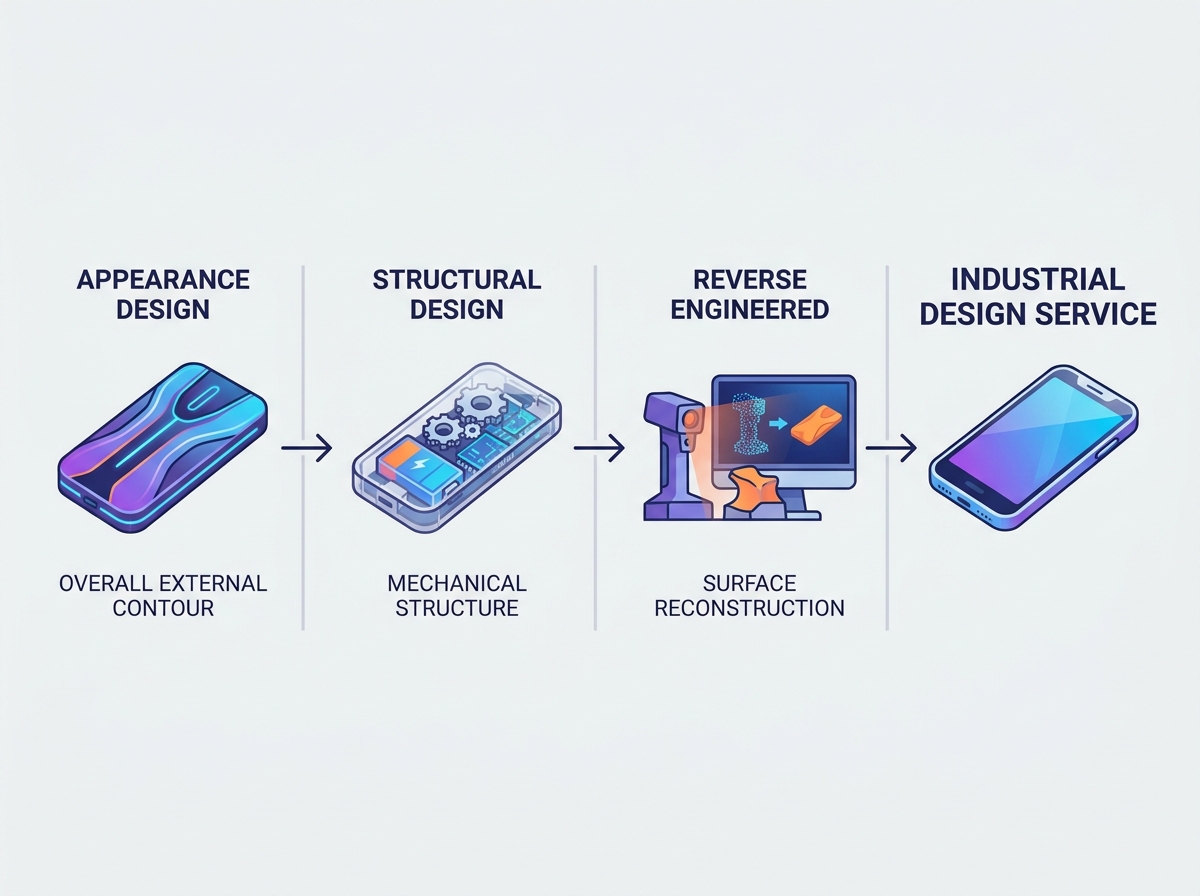
Certain projects necessitate a reverse engineered approach. Legacy part optimization often lacks original CAD data. Competitor analysis requires deconstructing existing products to understand their mechanical architecture. Developing aftermarket accessories demands precise interfacing with original equipment. Industrial equipment maintenance frequently relies on reverse engineering to replace obsolete components when the original manufacturer no longer supports the machinery.
Outline the hardware and software capabilities a vendor must possess. High-accuracy 3D laser scanning captures complex geometries. CT scanning is essential for inspecting internal structures without destroying the part. Coordinate measuring machines (CMM) provide the precise dimensional verification required for tight tolerances. A firm equipped with these tools can accurately digitize physical parts and establish a reliable baseline for further engineering.
Audit a firm's Reverse modeling workflow for accuracy and efficiency. The process must translate dense point clouds into clean, editable CAD data. Look for a systematic approach that identifies geometric intent rather than just wrapping a mesh over the scan. A skilled engineer will recognize that a scanned cylinder might be slightly warped and will model a perfect mathematical cylinder in its place to ensure proper fitment.
Technical benchmarks for high-quality surface reconstruction are critical. Focus on achieving Class-A surfacing for visible exterior components. Ensure geometric continuity (G2 or G3) from scanned point clouds. Poor surface reconstruction leads to visible defects in molded parts and complicates downstream engineering. If the surface patches do not align perfectly, the resulting CNC toolpaths will leave visible machining marks that require expensive manual polishing.
The transition from surface models to parametric solid modeling is a definitive milestone. Surface models define the boundary, but solid models provide the mathematical volume and mass. This transition must be seamless and error-free to ensure manufacturing readiness. A watertight solid model is the foundation for all subsequent engineering activities.
Robust solid models are necessary for finite element analysis (FEA) and mold flow analysis. They are vital for managing industrial equipment lifecycles and generating a precise Bill of Materials (BOM). Without a parametric solid model, accurate structural validation and automated toolpath generation are impossible. Engineers rely on the feature tree within the solid model to make rapid adjustments to wall thicknesses or hole diameters based on simulation results.
Identify the risks of impossible geometry early in the process. Ensure the design service conducts early-stage DFM reviews. Concepts that look great on screen may feature undercuts or wall thicknesses that cannot be molded. Early DFM catches these issues before tooling begins. Running a preliminary mold flow analysis can highlight potential weld lines or air traps that would compromise the structural integrity of the final part.
Discuss the trade-offs between rapid prototyping fidelity and final production material properties. 3D printed prototypes verify form and fit but rarely match the mechanical strength of injection-molded commercial-grade plastics or machined industrial metals. Account for these material differences during functional testing. A snap-fit joint that works perfectly in a printed resin prototype might shear off immediately when molded in a rigid polycarbonate.
Legal and contractual safeguards are required when sharing proprietary technology. An industrial design service will have access to your core innovations. Implement strict Non-Disclosure Agreements (NDAs) before sharing any technical specifications or market strategies. Protect your trade secrets by limiting access to sensitive information on a need-to-know basis.
Specify clear clauses regarding the ownership of deliverables. You must retain ownership of native CAD files, reverse engineered data, and final design patents. Ensure the contract explicitly states that all intellectual property generated during the project transfers fully to your organization upon completion. Never accept a contract that leaves the design firm with a license to reuse your custom mechanical solutions for other clients.
Analyze the engagement models of industrial design firms. Fixed-bid contracts offer predictability but may limit flexibility during iterative design phases. Time-and-materials models accommodate changes but require strict project management to control resource allocation. Align the engagement model with your specific project risk and timeline. Complex mechanical integrations often benefit from phased approaches where feasibility is proven before committing to full detailing.
Underinvesting in structural design during the conceptual phase is a common mistake. It leads to exponential resource drain during tooling, production, and equipment operation. Fixing a mechanical flaw during the CAD phase requires minimal effort. Modifying a hardened steel injection mold can devastate a project schedule and require extensive rework. Investing in thorough engineering upfront guarantees a smoother transition to mass production.
Evaluate how a design partner establishes a scalable design language. A strong visual identity should translate across multiple products. They should develop a modular mechanical architecture that can be leveraged for future product iterations. This approach reduces development time for subsequent releases and broadens commercial applications. Designing a universal battery compartment or a standardized mounting interface allows you to expand your product ecosystem rapidly without reinventing the core mechanics.
A high-performing industrial design service operates as a highly technical professional practice capable of bridging the gap between human-centered design and mechanical reality. Selecting the right partner ensures your product is visually compelling, structurally sound, and ready for efficient manufacturing. Your shortlisting logic must rely on critical evaluation lenses. Demand verifiable DFM experience. Scrutinize their advanced solid and reverse modeling capabilities. Ensure they have a proven track record of integrating external contours with internal structures across various industrial sectors.
To move forward effectively, execute the following steps:
Draft a highly technical Request for Proposal (RFP) detailing your specific material and manufacturing constraints.
Request sanitized DFM reports from prospective vendors to evaluate their engineering rigor.
Schedule a technical capabilities audit to review their solid modeling and surface reconstruction workflows.
Define clear milestones for the handoff between appearance design and structural engineering phases.
A: It is the professional practice of designing products, devices, and equipment used by millions, blending human-centered appearance design with rigorous structural engineering for commercial and industrial applications.
A: Appearance design focuses on user interaction, aesthetics, and the overall external contour. Structural design focuses on the mechanical structure, material strength, and manufacturability of the internal components.
A: Reverse engineering is necessary when CAD data for legacy parts is missing, when designing aftermarket components that must interface with existing products, or when conducting competitive benchmarking on industrial equipment.
A: Highlight the importance of clean, continuous geometry that accurately translates 3D scan data into editable CAD formats without deviations that could impact tooling or commercial production.
A: Solid modeling provides the mathematical volume and mass properties required for engineering simulations, structural validation, and precise CNC or molding toolpath generation.
A: Aggressive aesthetic curves or thin profiles can limit the space available for the internal structure, potentially compromising component placement, thermal management, or structural integrity.
A: Standard deliverables include concept renderings, parametric solid modeling files, DFM analysis reports, 2D manufacturing drawings, and functional prototype data.


